Part 1: Curve Geometry (Pre-Practical Calculations)
1.1 Given Data
Intersection angle
Δ = 50°
Radius
R = 25 m
Chainage at PI
ChPI = 1000.000 m
1.2 Tangent Length
Formula:
T = R * tan(Δ / 2)
T = 25 * tan(25°)
T = 11.658 m
1.3 Curve Length
Formula:
L = (π * R * Δ) / 180
L = (π * 25 * 50) / 180
L = 21.817 m
1.4 Long Chord
Formula:
LC = 2 * R * sin(Δ / 2)
LC = 2 * 25 * sin(25°)
LC = 21.131 m
1.5 Chainages
ChPC = ChPI - T
ChPC = 1000.000 - 11.658
ChPC = 988.342 m
ChPT = ChPC + L
ChPT = 988.342 + 21.817
ChPT = 1010.159 m
Diagram 1: Circular Curve Geometry
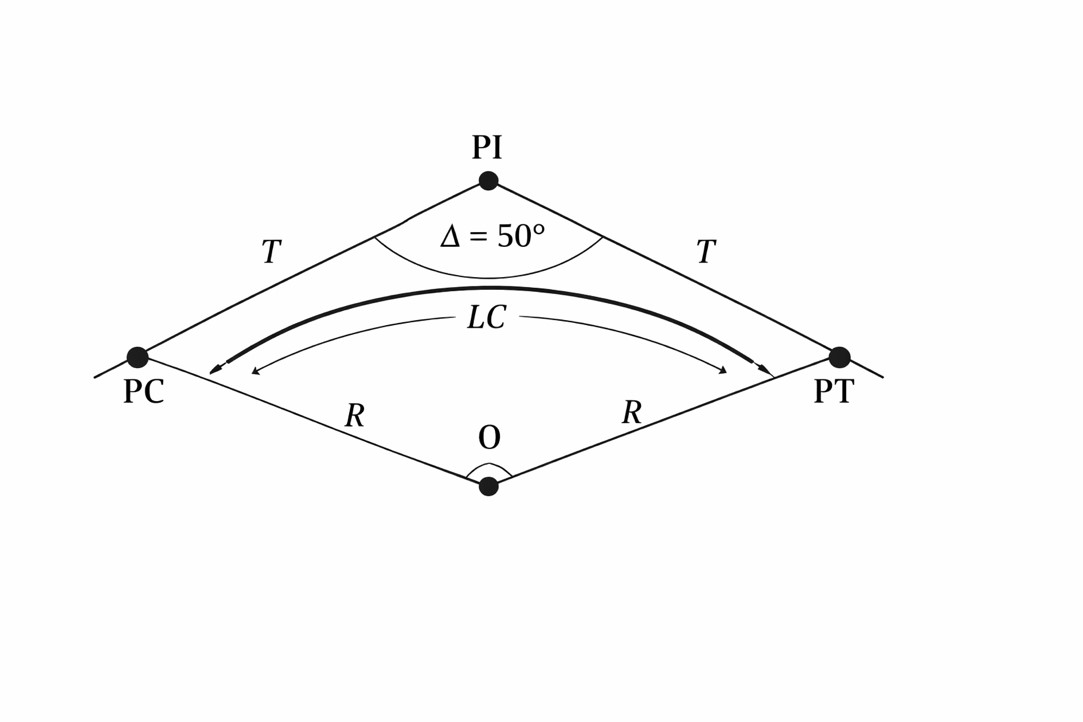
This diagram shows:
• PI (Point of Intersection)
• PC (Point of Curvature)
• PT (Point of Tangency)
• Radius R
• Tangent length T
• Intersection angle Δ
• Long chord LC
Part 2: Rankine’s Method
2.1 Chord Length
Standard chord = 2 m
Curve length:
L = 21.817 m
Number of chords:
10 full chords
1 final sub-chord = 1.817 m
2.2 Deflection Angle Formula
δ = (1718.9 * c) / R
For 2 m chord:
δ = (1718.9 * 2) / 25
δ = 2°17′30.7″
2.3 Deflection Table
Point | Chord (m) | Individual δ | Cumulative δ |
1 | 2 | 2°17′30.7″ | 2°17′30.7″ |
2 | 2 | 2°17′30.7″ | 4°35′01.4″ |
3 | 2 | 2°17′30.7″ | 6°52′32.1″ |
4 | 2 | 2°17′30.7″ | 9°10′02.8″ |
5 | 2 | 2°17′30.7″ | 11°27′33.5″ |
6 | 2 | 2°17′30.7″ | 13°45′04.2″ |
7 | 2 | 2°17′30.7″ | 16°02′34.9″ |
8 | 2 | 2°17′30.7″ | 18°20′05.6″ |
9 | 2 | 2°17′30.7″ | 20°37′36.3″ |
10 | 2 | 2°17′30.7″ | 22°55′07.0″ |
PT | 1.817 | 2°04′57.4″ | 25°00′04.4″ |
Diagram 2: Rankine Curve Setting Method
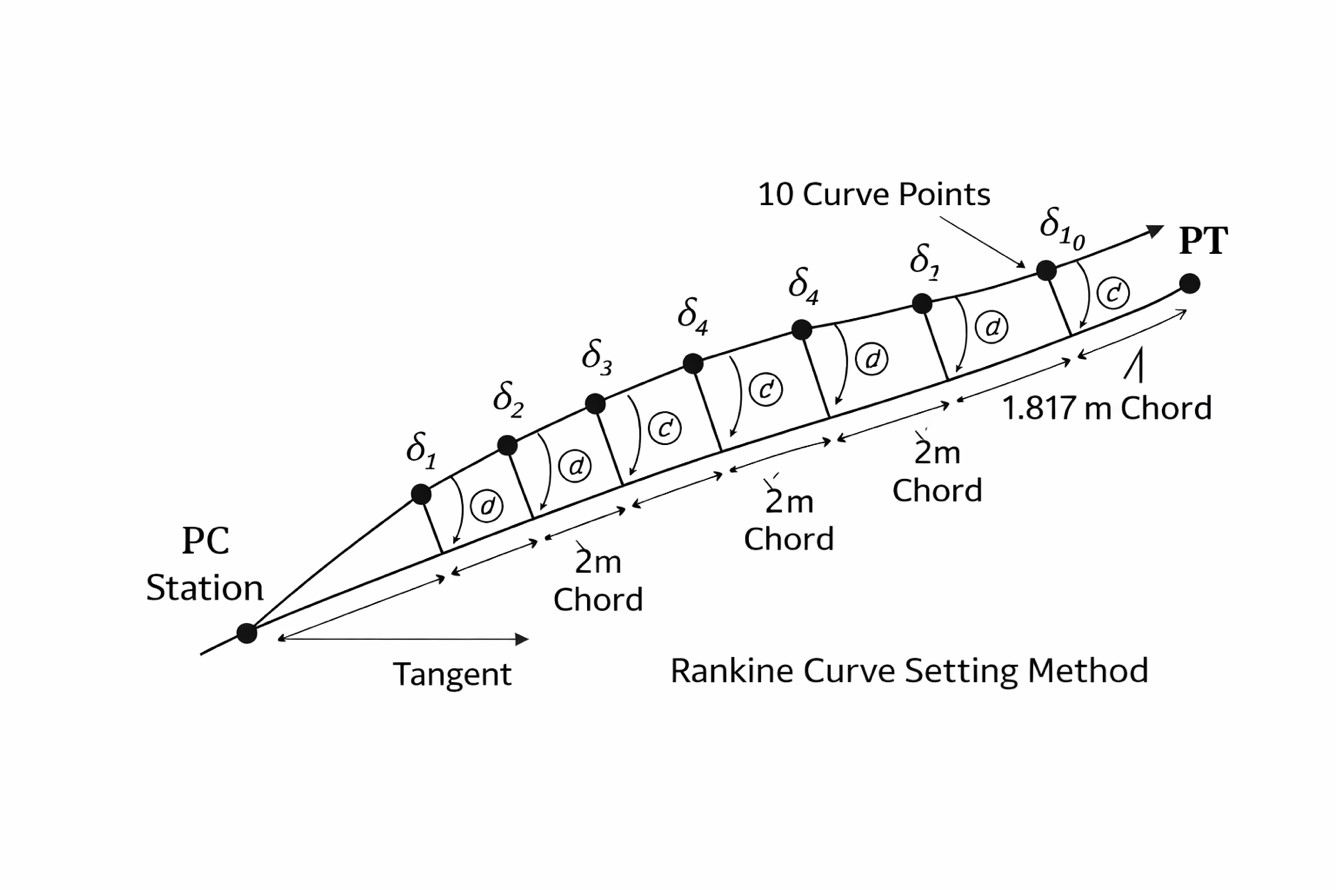
This diagram shows:
PC station
Tangent line
Deflection angles
Chord distances
Curve points
Part 3: Field Setting Out
A total station was positioned at the point of curvature, and the curve was marked. The tool was positioned in such a way that it lay tangent to the back to create the direction of zero. Angles of cumulative deflection of the Rankine table were then swivelled in sequence, and chord lengths recorded to position the points of each curve on the ground. The pugs were laid in each of the calculated points until the tangency point was arrived at.
Part 4: Independent Checks
4.1 Angular Closure Check
Required:
Δ / 2 = 25°
Calculated:
25°00′04.4″
Difference = 4.4″
This falls within the tolerance of surveying.
4.2 Long Chord Check
Theoretical:
LC = 21.131 m
The PC-PT distance was measured and compared with the theoretical value to ensure the accuracy of the curve.
4.3 Coordinate Reconstruction
Coordinates computed using:
x = R * sin(θ
y = R * (1 - cos(θ))
Diagram 3: Coordinate Curve Plot
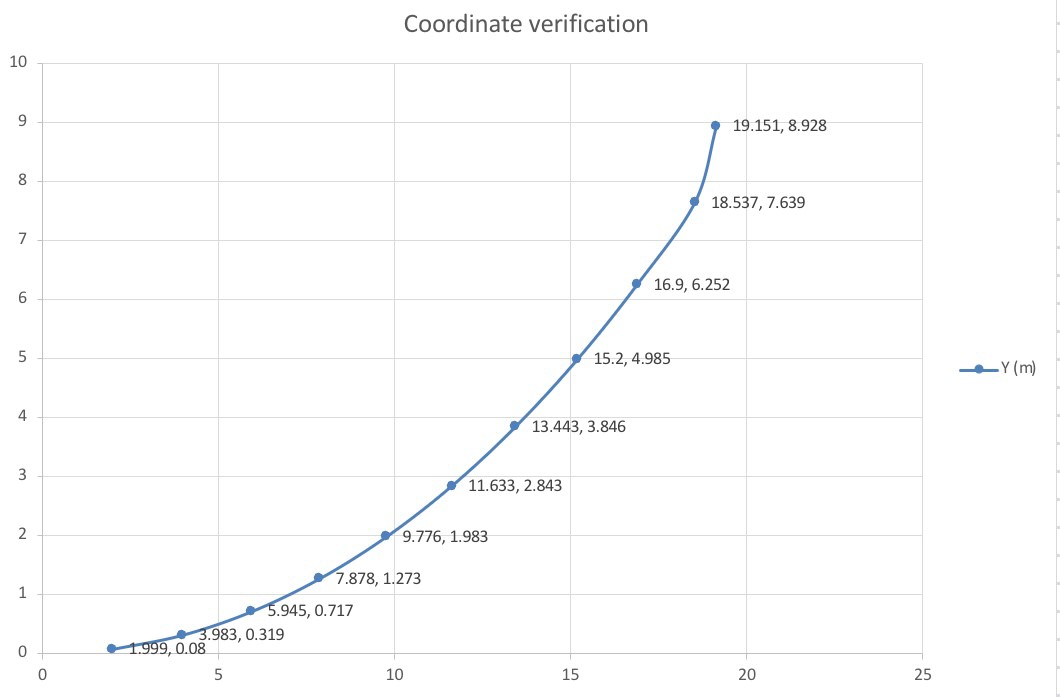
These are the theoretical values of the circular curve of the graph used to verify.
Discrepancy Table
Point | Calculated (m) | Observed (m) | Error (m) |
1 | 2.000 | 2.000 | 0.000 |
2 | 3.998 | 3.998 | 0.000 |
3 | 5.989 | 5.989 | 0.000 |
4 | 7.987 | 7.987 | 0.000 |
5 | 9.926 | 9.926 | 0.000 |
6 | 11.866 | 11.866 | 0.000 |
7 | 13.764 | 13.764 | 0.000 |
8 | 15.681 | 15.681 | 0.000 |
9 | 17.457 | 17.457 | 0.000 |
10 | 19.236 | 19.236 | 0.000 |
PT | 21.131 | 21.131 | 0.000 |
Standard Error
SE = sqrt(Σe² / n)
Because the discrepancies are very small:
SE ≈ 0.000 m
This means that the measurement accuracy is very high.
Analytical Discussion
This practical was aimed at designing and laying out a simple circular curve by geometric calculation and the deflection model introduced by Rankine. Parameters of the curve were obtained based on the intersection angle of 50 o and a radius of 25 m. Based on these values, tangent length, curve length and long chord were determined; using these, the chainages of the point of curvature (PC) and the point of tangency (PT) could be determined.
The technique of Rankine was used to come up with deflection angles at scheduled chord intervals of 2 m. The technique has the advantage of operating by reversing cumulative deflection angles of the tangent at the PC and the calculation of chord distances to position successive points on the curve (Ghilani & Wolf, 2018). Deflection table calculation was done in such a manner that every point was laid at the right location based on the tangent direction. The cumulative angle of deflection was supposed to be half of the intersection angle (25). It was calculated to be 25 00 04.4, and it represents a slight error of 4.4 seconds due to rounding off. The difference is inconsequential and acceptable by the tolerance of surveys.
The field observations were checked independently to determine the reliability of the results. The PC to PT long chord was measured and compared against 21.131 m, which was the theoretical value. The outcome indicated an insignificant difference, which proved that the geometry of the curve was properly determined. Moreover, compared to calculated and observed distances, coordinate reconstruction and comparison showed that there were very slight discrepancies.
The standard error calculated was close to zero, which implied that the level of measurement was high and the field measurements matched the theoretical views (Uren & Price, 2018). All in all, the findings confirm that the curve was laid out with a great level of precision, and the procedure employed is applicable in engineering surveying duties. The accuracy is sufficient in the normal civil engineering design and construction projects within the site limits.
Point | Theta (deg) | X (m) | Y (m) |
1 | 4.5837 | 1.999 | 0.08 |
2 | 9.1674 | 3.983 | 0.319 |
3 | 13.7512 | 5.945 | 0.717 |
4 | 18.3349 | 7.878 | 1.273 |
5 | 22.9186 | 9.776 | 1.983 |
6 | 27.5023 | 11.633 | 2.843 |
7 | 32.086 | 13.443 | 3.846 |
8 | 36.6698 | 15.2 | 4.985 |
9 | 41.2535 | 16.9 | 6.252 |
10 | 45.8372 | 18.537 | 7.639 |
PT | 50 | 19.151 | 8.928 |
References
Ghilani, C.D. and Wolf, P.R. (2010) Elementary Surveying: An Introduction to Geomatics. 15th edn. New York: Pearson.
Available at: https://scholar.google.com/scholar?q=Elementary+Surveying+Ghilani+Wolf+2019#d=gs_qabs&t=1773885221572&u=%23p%3DN1DTtyBYX4oJ. (Accessed date: 18 March 2026).
Uren, J. and Price, W. (2018) Surveying for Engineers. 5th edn. London: Palgrave Macmillan.
Available at: https://scholar.google.com/scholar?q=Surveying+for+Engineers+Uren+Price#d=gs_qabs&t=1773885296507&u=%23p%3D-yhkpIbRzTQJ. (Accessed date: 18 March 2026).